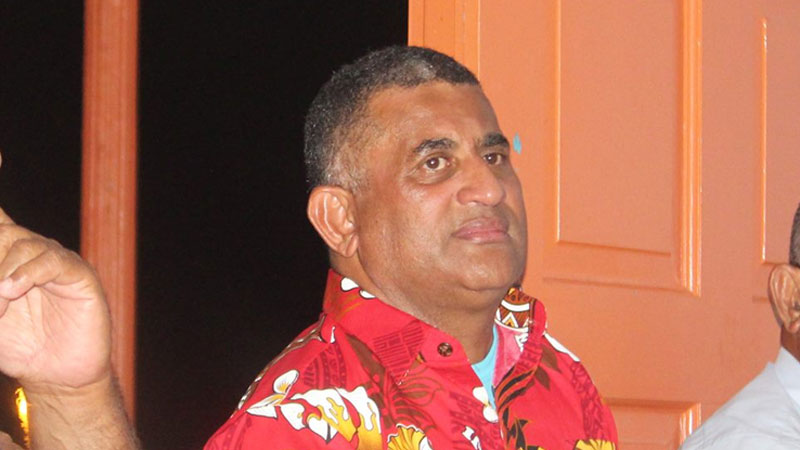
The Director of the Human Rights and Anti-Discrimination Commission Ashwin Raj says the 2020 report on human rights in Fiji issued by the US State Department is perfunctory, scant in its interpretation and deconstruction of the law, saturated with generalisations and selective in its treatment of facts.
Raj says while the report impugns independent institutions like the judiciary and those responsible for the protection, promotion and preservation of human rights, there was neither any consultations with the state and independent institutions including the Human Rights and Anti-Discrimination Commission in the formulation of this report nor any ethic of constructive engagement over the years, as far as the Commission is concerned, in relation to human rights in Fiji.
Raj further says this does not mean that Fiji does not have any human rights challenges, we certainly do.
The Commission Director says they include but by no means limited to sexual and gender-based violence, torture and brutality at the hands of law enforcement agencies, rights of arrested and detained persons, racial and religious intolerance and hate speech, the need for constructive discussions on the right to peaceful assembly and the imperatives of public order and national security, the existential threat of climate change and the advent of COVID-19 and its attendant human rights challenges, and the need to ensure that the national human rights institution is compliant with the Paris Principles but Fiji continues to subject itself to scrutiny both domestically and at the highest human rights forums internationally, the most recent being the third cycle of its Universal Periodic Review at the Human Rights Council in Geneva.
Raj adds curiously the US State Department Report does not even make a cursory reference to Fiji’s Universal Periodic Review almost giving an impression that there is no accountability for human rights violations in Fiji, nor does it document Fiji’s human rights achievements.
Raj says just like the United States, Fiji is equally concerned with torture and other cruel, inhuman, or degrading treatment or punishment and we have acknowledged this at home and internationally and the need for accountability without impunity for acts of violations of human rights.
He says the claims about carte blanche immunity extended to security forces, however, is a distortion of the law and a complete misrepresentation of section 157 of the Fijian Constitution giving an impression that this provision is still being invoked in present day cases of torture and brutality to exonerate security forces.
Raj also says the US human rights record is hardly worthy of emulation but Fiji does not occupy an indomitable moral plateau with the compulsion to ritualistically produce a report on them every year.
Raj says the US is a country that until recently had turned its back on the Paris Climate Agreement, had withdrawn from the UN Human Rights Council, placed sanctions against the International Criminal Court and has yet to ratify all core international human rights instruments.
He says these are the Convention on the Elimination of all forms of Discrimination Against Women, International Convention on the Protection, Convention on the Rights of the Child, International Covenant on Economic, Social and Cultural Rights, Convention on the Rights of Persons with Disabilities, International Convention on the Protection of the Rights of All Migrant Workers, and Members of Their Families, International Convention for the Protection of All Persons from Enforced Disappearance, Rome Statute of the International Criminal Court.
Raj further says it has yet to establish an independent national human rights institution adding that at the third cycle of its Universal Periodic Review, member states called on the USA to establish a moratorium on death penalty, to put an end to life without parole sentence for juveniles, an end to arbitrary and indefinite detention, illegal and secret detention facilities, overcrowding in prisons, police violence, use of excessive force and torture, racial profiling by law enforcement agencies, killing of civilians in military operations, gun violence, racism, extremism, xenophobia and hate speech directed at immigrants and asylum seekers, the adoption of punitive measures such as the incarceration of migrants and separation of migrant children from their parents to deter irregular entry and retrogressive policies that inhibit comprehensive and universal access to voluntary sexual and reproductive health services.
Earlier;