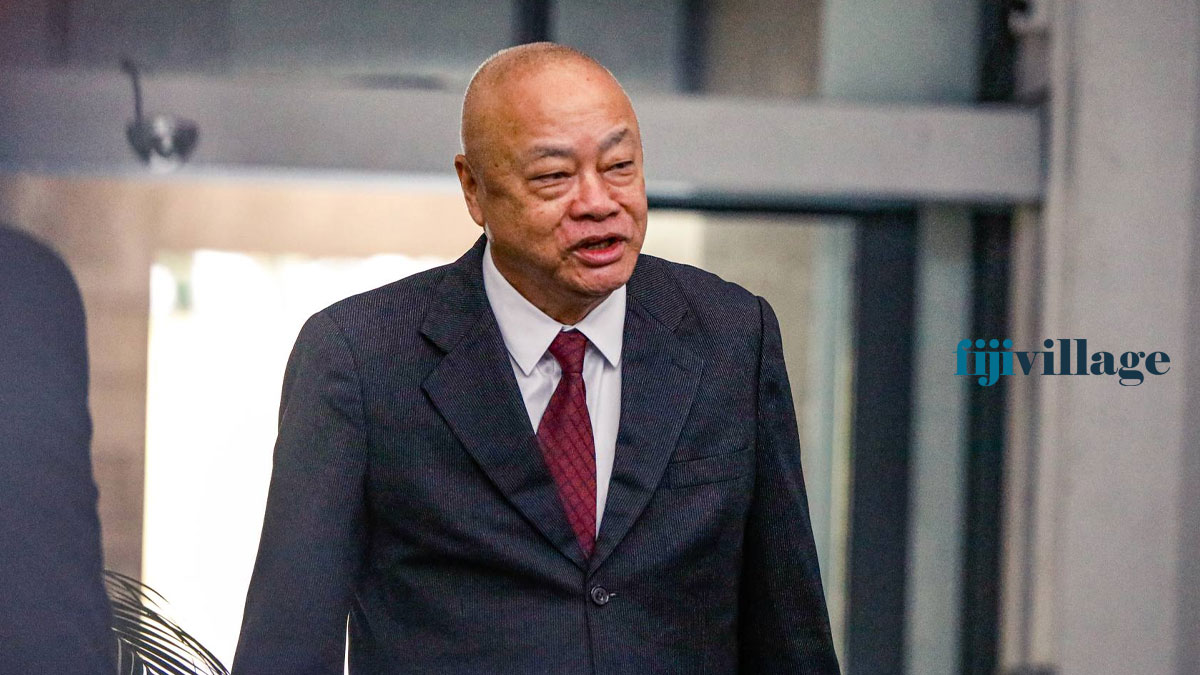
![Attorney General Graham Leung speaking at Vunimono High School. [Image: Supplied]](https://www.fijivillage.com/news_images/43253471667dcfbdb08131a4d9f227.jpg)
In 1987, 2000, 2006 we experienced some racial incidents, and some of the worst riots in our history took place.
Our country was sorely tested at times.
We came close to the edge of a cliff, but we did not fall. In large part, this was due to the goodwill of the majority of ordinary people in this country.
Those were the words of Attorney General, Graham Leung as he spoke to principals, teachers, parents and students at Vunimono Community Hall to mark International Day for the Elimination of Racial Discrimination.
Leung says we have managed to largely preserve the social order and harmony for which we are known however, these periods of lawbreaking and lawlessness set us back, caused damage to race relations, and eroded the trust between our different communities.
He says he takes immense pride in his multicultural heritage.
He says his father Lambert was born in Fiji in 1926.
His grandfather came from Southern China to Fiji in the early part of the 20th century.
Leung says his father met and married his mother Fanny in Levuka.
Her father was Chinese and her mother was an indigenous Fijian woman from the village of Muanisolo, Kadavu.
Leung says in Levuka, his parents befriended a iTaukei family, the Vuetis who lived in Draiba Village in Ovalau.
He adds Levuka was something of an ethnic melting pot in those days.
The Attorney General says their neighbours included an Indo Fiji family who ran a laundry, and his parents had a wide circle of friends of different races – they included Doctor Arthur Dass and his wife Maureen, the Youngs, Sandys, Pattersons, Doctor Ratu Dovi, the younger brother of Ratu Sir Lala Sukuna, and many others.
Leung says they often stopped by for a cup of tea, to play cards or to yarn.
He says Doctor Dovi’s son, the late Ratu Joni Madraiwiwi and he were childhood friends, and went onto university, and studied law and later worked together in the Attorney General’s Office, as lawyers.
Ratu Joni was to become a High Court Judge and Vice President of Fiji.
The Attorney General says Fiji has had its difficult and challenging moments — times when racial and ethnic divisions have threatened our unity as a nation but if we look beyond our shores, we see that in many places around the world, it has led to even greater suffering — wars, oppression, and even genocide.
He says in every case, it started the same way : by convincing people that their neighbours were not brothers and sisters, but "others" — people to fear, people to keep at a distance, people who are inferior.
Leung says this is why we must be vigilant as we cannot allow these seeds of division to take root.
He stresses that Fiji must never be a country where anyone feels like a stranger in their own land.
He says “to anyone who might even suggest that Fiji is not home to those who are not iTaukei, I say to you today as a descendant of immigrants, reject those feelings.”
Leung says those thoughts are racist, and they run against the tide of history.
He says this is not who we are, and he knows the majority of people in this country are peaceloving and kind.
Leung stresses that let us not be distracted by extremists of any colour.
He says history will not judge them kindly.
The Attorney General says what unites us is far greater than what divides us.
He says if we can recognize this truth when we are far from home, why do we sometimes struggle to see it when we are standing side by side in our own country.
He adds our diversity should be a cause for celebration because it is one of our strengths.