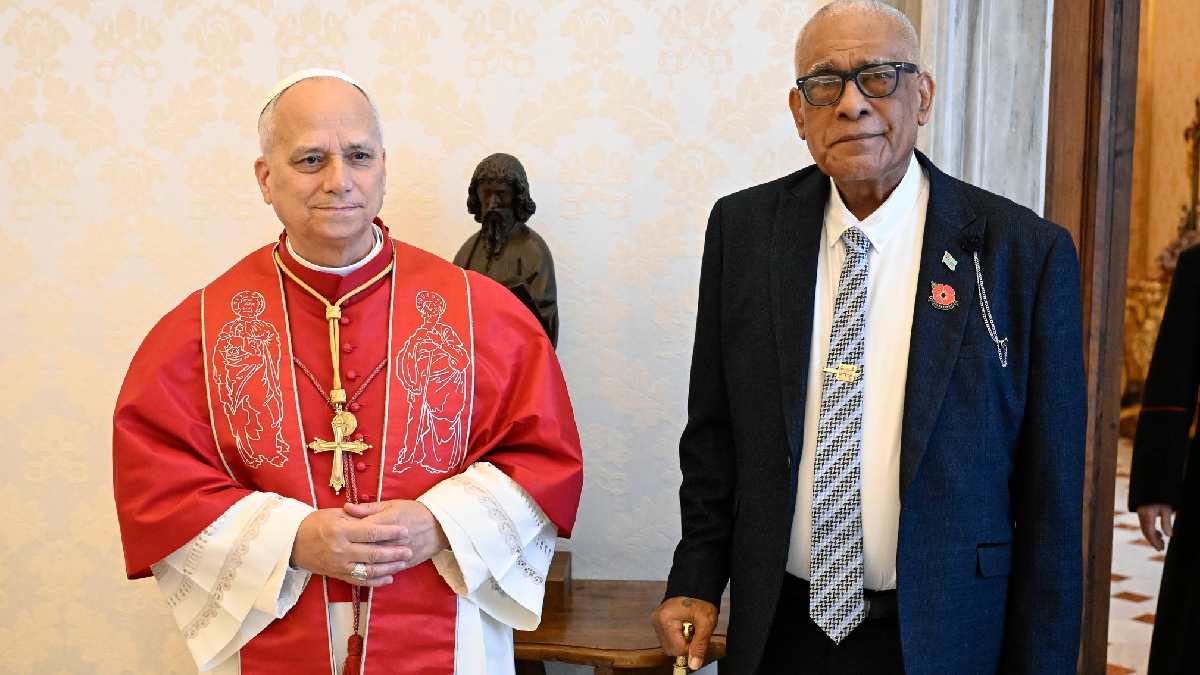
President Ratu Naiqama Lalabalavu has has met with Pope Leo XIV a and has invited him to visit Fiji and, by extension, the Pacific region.
Ratu Naiqama met with the Pope and Cardinal Pietro Parolin, Secretary of State of the Holy See, at the Apostolic Palace.
The meeting provided an opportunity to further strengthen relations between Fiji and the Holy See, and to exchange views on issues of shared moral and global importance; including climate change, social wellbeing, education, and resilience through faith.
The President recalled that the last Papal visit to Fiji was made by His Holiness Pope John Paul II in 1986.
In a statement, the Fiji Government says such a visit would carry immense regional significance for the Pacific Islands, highlighting the spiritual bond between the Holy See and the peoples of Oceania.
Ratu Naiqama advised that follow-up discussions would be undertaken with the Archbishop of Fiji.
He expressed deep appreciation for the transformative role of the Catholic Church in shaping communities across Fiji and the Pacific; guiding lives through faith, education, and service.
The President also raised the pressing social challenge of drug abuse, noting that the Pacific is increasingly being used as a conduit for the trafficking of illicit substances, with devastating effects on youth and families.
He encouraged the Church to continue playing an active role in moral guidance, awareness, and rehabilitation, particularly among young people.
Both leaders reaffirmed the importance of partnership and shared humanity, agreeing that faith and moral conviction must continue to guide international cooperation.
The President described the visit to the Holy See as especially meaningful as it coincides with the Year of Jubilee, a sacred time for renewal, reconciliation, and unity in faith.
Climate change featured prominently in the discussions with Ratu Naiqama underlining the vulnerability of Small Island Developing States such as Fiji, Tuvalu, and Kiribati, where the effects of sea-level rise have already forced the relocation of communities.
Ratu Naiqama noted that this comes at a profound social cost with the loss of homes, heritage, and identity.
He also raised the issue of food security, pointing out that saltwater intrusion and changing weather patterns threaten the agricultural foundations of Pacific societies.
The President further emphasised the need for resilience through faith, calling for the Church’s continued support to the eighteen Pacific Island nations in their efforts to sustain hope, social cohesion, and community resilience in the face of growing environmental challenges.
Cardinal Parolin reaffirmed the Holy See’s solidarity with Small Island Developing States and its shared concern for climate justice, underscoring the moral duty of developed nations to assist the most vulnerable through adaptation, mitigation, and resilience initiatives.
Both leaders reflected on the concept of climate debt, stressing that nations most responsible for global emissions have an obligation to help those suffering its worst effects.
Cardinal Parolin also confirmed that the Holy See will speak on the ethical dimensions of climate change at the upcoming COP30 in Belém, Brazil, urging developed countries to change consumption habits and lifestyles as part of a moral transformation towards sustainability.
The two sides also discussed the importance of education in nurturing environmental stewardship and appreciation of creation, and the Holy See’s willingness to explore how SIDS can be supported under international frameworks, including through a joint moral voice within the United Nations.
Ratu Naiqama and the Pope also addressed the need to clarify the definition of “refugee” in the context of climate change, noting that existing UN frameworks primarily recognise victims of war and political instability.
They agreed that climate-displaced persons should be acknowledged and protected, and that COP30 provides a vital platform for SIDS to present a unified voice, calling for Action Now on loss and damage, as pledged by developed countries.
Also discussed was the Ocean of Peace Declaration, recently endorsed by the Pacific Islands Forum Leaders in Honiara, which promotes the Pacific as a region of peace, respect, and cooperation — where the ocean is recognised as both a source of life and a cornerstone of identity and culture.
The meeting concluded with a shared understanding that the Year of Jubilee provides a timely reminder for nations to work together with compassion, equity, and responsibility for the planet and its people.